Every roofing conversation lands on the same question eventually. Is this a repair, or is it time to replace the whole thing?
It is a fair question, and the honest answer is that it depends on what is actually failing. A roof does not wear out evenly. One valley can leak while the other slopes still have a decade left in them.
A vent boot cracks after fifteen years and lets water in above a bathroom. That is a repair, not a tear-off. On the other hand, a roof losing granules across every slope is telling you the shingles are finished. Patching one section there only moves the leak somewhere else, and you will be back on the phone in eight months.
The difference matters because the two jobs are not close in price. Nobody should be sold a replacement they do not need. Nobody should keep pouring money into repairs on a roof with one winter left in it either.
Here is how to tell which one you are looking at.
Signs a Roof Repair Is Enough
Damage that is contained to one area usually means repair. A few shingles blown off after a windstorm, a cracked vent boot, a lifted ridge cap, or flashing pulling away from a chimney are all localized failures.
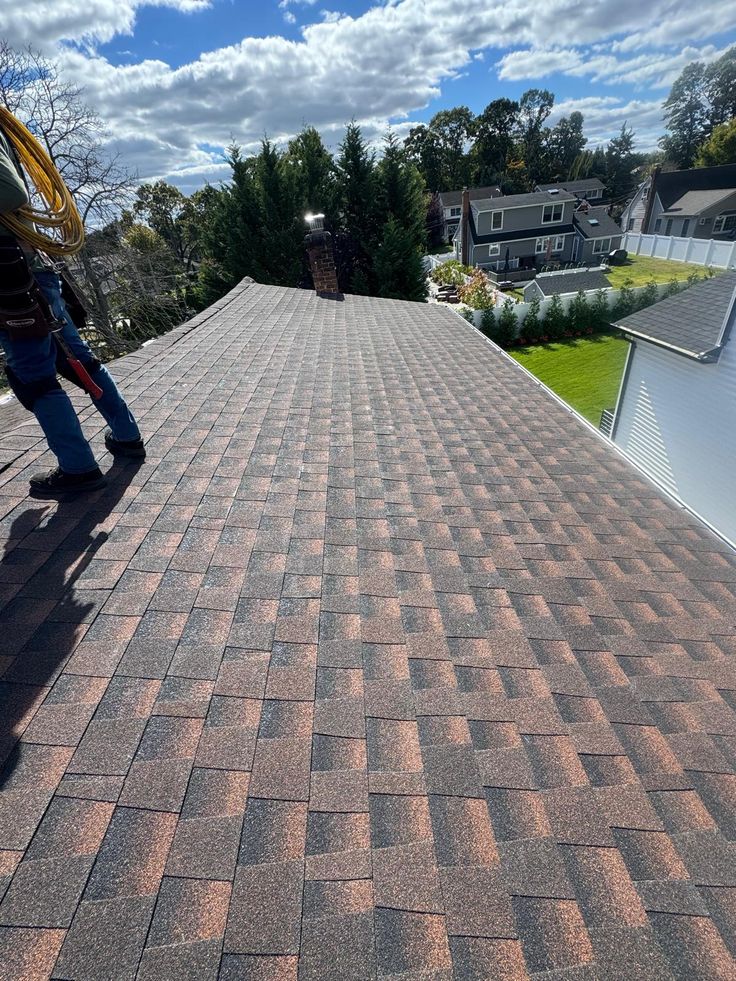
The rest of the roof is the tell. Walk the perimeter and look up. If the shingles across the other slopes still lie flat, still hold their granules, and still look like shingles rather than gray paper, the system is intact.
Age helps here too. A roof under fifteen years old with one problem spot is almost always a repair. So is a leak that traces back to a penetration, because the failure is the seal around it, not the field of the roof.
Signs the Roof Is Done
Curling and cupping across whole slopes means the shingles have lost their flexibility. They will not seal back down, and every wind event lifts more of them.
Bald patches are the clearest sign. When granules wash into the gutters in quantity, the asphalt underneath is exposed to sunlight and it hardens fast after that. Check the bottom of the downspout in spring. A pile of granules there is the roof telling you its age.
Leaks in more than one place point the same direction. So does a sagging line along the ridge or between rafters, which usually means the decking has been wet for a long time. That one is structural, and it does not get patched.
What the Age of the Roof Tells You
Asphalt shingles in New Hampshire live a hard life. Freeze and thaw cycles, ice at the eaves, snow load, and summer heat all work against the same surface.
Most architectural shingle roofs give you somewhere in the twenty to thirty year range. Three-tab shingles run shorter. Ventilation changes the number more than most homeowners expect, because a roof that cooks from underneath ages years faster than one that breathes.
If you do not know the age, look for clues. A permit record, a previous owner, or the layer count during an inspection all help. Two layers of shingles usually means the next job is a full tear-off regardless of condition.
How to Compare Two Estimates Honestly
Repair estimates and replacement estimates answer different questions, so comparing the totals alone tells you very little.
Ask what the repair actually buys you. If a contractor says a repair holds the roof several more years, ask what he saw that makes him say it. Ask what happens to that answer if the decking underneath turns out to be soft.
On a replacement, look at what is included beyond shingles. Decking replacement allowance, ice and water shield coverage, drip edge, flashing, ventilation, and cleanup all belong on the page. Two quotes that differ by thousands usually differ in those lines, not in the shingle brand.